Thursday, December 27, 2007
Abstract?
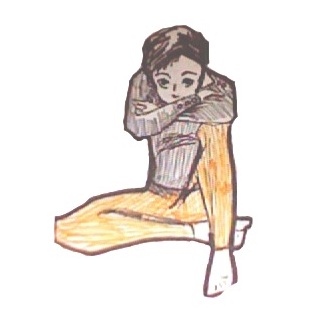
Reinvention by ~Shmedgehog on deviantART
What do you think? Acrylic and graphite on paper. My Hamlet designs are over on deviantArt now, so go check those out if you've never seen them.

Wednesday, December 26, 2007
Goodness me
I need someone to talk to who isn't a relation or relative.
Tonight we had people over for dinner, one of which told me Avril Lavigne's life story, one who said that he trusts Bill O'Reilly, and one who said that she loved the Bush family. Carla was there too, and she's good to be around. But really...I had to keep punching myself in the leg to stop from saying anything liberal or intelligent or sounding like a smartass. Which I think is totally unfair.
I'm tired of eating and listening to Christmas music, and now that I have a lovely new Operating System I don't know what to do on it. And I'm tired tired, too. Tomorrow I get to sleep in and ignore the phone and do nothing, and play guitar and get away from the stifling family for at least a few hours.
I'm thinking of exchanging my gift cards with money to go towards more memory for the lappy. I would just be buying things I don't need to take with me anyway.
God I feel so morbidly bored. I need to take a shower and read more Milton.
And I need to be in a place where I can be around people who think that reading Milton and not confusing Salvador Dali with Henri de Toulouse-Latrouec is important.
Boxing day blues
My family needs a break. We've been running around putting together schedules and get-togethers and Pre and Post-Christmas festivities. We need a day where go out to a movie and order a pizza.
I've been sprucing up the computers with OS Leopard, and while I was going through some of my old old documents, I came across this story that I wrote when I was, like, 16:
She only read the letter once. It sat unfolded on the table of the cafe, bright white from the July sun that beat down upon it.
Dear Helen,
I am writing on a sad occasion. You're friend, Joanna Hamilton, was struck by a city bus yesterday and was killed. Mrs. Hamilton has only just told me, and I feel that it is important that you know, since I remember how much you and Joanna were friends. I am sorry to have to tell you this. Please write or call, the funeral will be this week-end.
Love always,
Mother
Helen Gilman folded the letter and put it back in the envelope that it had arrived in. She sipped her water and ate her sandwich in silence. Helen had not seen or heard of Joanna Hamilton since they graduated high school. Joanna stayed home and got a job at the local soda fountain, Helen went to college fifteen hundred miles away. That had been three years ago, when the class of 1966 had taken their graduation pictures. Joanna had held onto Helen's shoulder, kindly looking into her brown eyes and talking about how they needed to write to each other to keep in touch. Joanna had sent one letter, but Helen had become so swept into the world of college that she had never opened it. The world that she had left behind meant little to her then, and Joanna had been part of it. The letter was now somewhere in Helen's desk.
Helen didn't cry, nor did she write or call her mother. She felt no need to; Joanna was dead, and that meant hardly anything in her life. Joanna Hamilton had become a worn black and white photograph in Helen's technicolor world, the loss waned in comparison to the battles Helen had fought and lost and overcame in the past three years.
She finished her lunch and stood up, throwing the letter away with the used plate and cup. She had known people to die before. Her brother had been drafted to Vietnam in 1966, two years later he came home in a coffin, a hole in the side of his head. One of Helen's friends had been beaten brutally in a riot, he died a few days later of internal bleeding. Helen had known people to die, and the death of her brother in a war and her friend protesting that same war were more significant that Joanna being struck by a bus.
Helen walked home, down the street and across the campus to her dormitory room. The sky was clear and blue, the sun heating the dark hair on Helen's head. She passed a few friends in the field, and two young men, Roger and Chris, came over to walk with her, talking about the plans that they had for the rest of the week. A man millions of miles away was scheduled to land on the moon the next day, and the entire country was buzzing with excitement. Helen shrugged at the topic, trying to wonder how a man walking on the moon was going to solve any of the world's problems. It would be a decent distraction, though, she mused. Roger chuckled and asked her to come over to his house that night; a few friends were coming over too, including Helen's roommate Melissa. Helen agreed, and the two men turned around to go back to the group in the field, Roger turning around once more to wave goodbye. Helen smiled and waved back. He did look handsome that day.
Helen's dormitory room was at the topmost floor of the building. It had been the attic, but it became a room when another dormitory building had burnt down and the students had nowhere else to go. Helen opened the window and turned on the ceiling fan. She lay on her small bed, looking up at the rafters that held up the roof of the building, before sitting up and reaching into the bottom drawer of her desk, pulling out an old, yellowed envelope with her name and address written delicately on it. She looked at it, her eyes tracing up the stems of the flowers that were printed on the paper. She tore open the envelope and unfolded the letter, which was written on matching flowered paper. She wondered if Joanna had changed, if she had avoided a correspondence with someone who might have been protesting the war and the injustices in the world at the same time as Helen had. But it took only four lines of the letter to prove these suspicions wrong, and Helen crumpled the paper in disgust, tossing it into the trash along with the envelope.
She went to sleep, and woke up when Melissa came in, home from shopping. They talked for a while, about the moon landing and the upcoming year and the war. Helen had taken part in this conversation before, and her responses were robotic, her eyes fixed on the ceiling. She turned over in bed, toying with a silk scarf on the table, a birthday present from her parents. She had not gone home to see them that summer. She loved them, but never had the urge to get on a plane and go home. It was too far away, and had stopped feeling like home altogether.
Melissa shrugged at Helen's complacency and asked her if she was going to the party that night. Helen nodded, but said that she wanted to take a shower first, so she picked up a towel and went down the hall to the bathroom.
The water was warm, but the heater for it was small. Helen didn't care, though. She sat down, her back against the wall of the shower, and let the cold water fall upon her. She though back to when she was young, when her parents had taken her and her brother to Niagara falls. She remembered asking if she could stand under the waterfall, and just let it all fall down upon her. No, her father had told her. The water was cold and deep, and the pressure from the waterfall was dangerous. But for the next few weeks all that Helen could think about was the feeling of all that water rushing onto her, and she wished for the sensation that she imagined, the cool rush and relaxation of the pummeling, churning water upon her.
Her daydreams were broken by another girl from the dormitory pounding to the door, yelling for her to come out. Helen turned off the water and dried herself, then went back to her room, telling the girl at the bathroom door that she had used all of the hot water. The girl frowned and walked away to wait for the heater to fill up again.
Helen dressed, then she and Melissa walked the few blocks to the house that Roger and Chris shared. A few people were there already, sitting and eating. Helen said hi to those she knew and hello to those she was introduced to. She sat down on the couch next to Roger and looked out the window at the sunset. The darkness set in, and they lit candles, changing everyone in the room into flickering ghosts.
The conversation drifted from the war to the moon to the weather to the economy and back to the war. Helen listened mostly, interested more in what people said than the actual subject at hand. One of the other students had brought grass with him, and they rolled a few marijuana cigarettes to pass around. The smoke filled the room, and drifted into Helen's lungs as she inhaled. She and Roger shared one for themselves, and she let herself relax, let her body be closer to his as he put his arms around her slowly. Her lips trembled with anticipation as he brought his face closer to hers. They kissed, and she opened her mouth and breathed in the smoke from his. They brought each other closer and closer, until she felt herself completely intwined with him. Another one of the students laughed, chiding them. Roger looked down at Helen, and there was a silent agreement between them. Roger handed the joint to the laughing student and led Helen upstairs to his bedroom.
They fell on the bed together, tearing away the apprehension with their clothing. She was under him, Roger was nibbling her ear, he was kissing hard on her neck and chest, they were moving together, crying out in passion and revelry. The drug they had taken only heightened their senses, and each of his warm touches sent a fire through Helen that could not settle. When they had tired, Roger fell beside her with a grunt of exhaustion. She sat up in bed, breathing deeply. She looked down at him, his skin shining from the sweat of lovemaking. He smiled, and she smiled at him. They rested, and then began to talk quietly, not about the war or the moon, but about the things that lay beneath those subjects, the things that started war, the desires that sent men to the moon. But somehow, Helen was not as impassioned about these things as the man lying next to her. He started to talk about how they could change the world, how they were adults now.
And then, for no apparent reason, Helen realized it. She realized that they were not adults, they were just children, that talking about the war was just philosophical jargon that changed nothing, that landing on the moon was a waste of time, that there was no us or them, no me and you, there was only a person or all of humanity. She realized that if there was an afterlife, no one would ever know what it was, and that the earth was just one tiny speck in one giant void. She realized that love and flowers were beautiful, but that lovers left and flowers wilted and old age would bring grief and pain and memory loss. Helen saw it all flashing before her, like a deluge of water over her.
"Niagara Falls." She whispered.
Roger had fallen asleep. She smiled sadly at him, knowing that she had just learned more than he would ever know. She slipped out of the bed and dressed quietly, not even looking for Michelle as she wandered back outside.
That night, Helen Gilman went home and hung herself from a rafter in her dormitory room. It wasn't very high off the ground, all that she had to do was kick away the kitchen table chair that she was standing on. Nine hours and ten minutes later, nobody knew, because nine hours and ten minutes after Helen broke her own neck a man was stepping out of a small capsule and onto the moon. All of Helen's friends and family were watching in awe, doing their best to remember where they were so their children and grandchildren could hear about it from them.
Melissa had spent the night at Roger's, and came home later that afternoon. She gasped when she walked into the room, And called Roger immediately to help take her down. They cut the silk scarf that Helen had used to kill herself and laid her gently down on the bed. Neither of them cried, too pale and shaking from the shock. Neither had ever seen a dead body this closely. Roger ran his hand over Helen's face, closing her vacant eyes and shuddering as his fingers brushed over the now purple mark on her neck where he had kissed her the night before.
Melissa looked around the room for a note. She finally found it, sticking out of the pocket of Helen's jeans. She unfolded the note slowly and with trembling fingers. Roger read it over her shoulder.
Melissa folded the note once more and looked at her friend. the words had explained nothing. Melissa crumbled it into a ball in her fist, putting her elbows on the bed and resting her face in her hands. Roger said nothing, looking out the window at the other students on the field below, who were taking advantage of the warm, clear July afternoon.
They decided to tell Helen's parents in person. Melissa, who knew the family a little more than any of the other students, went to tell them. It was not the first time that Mrs. Gilman had opened her door to such an announcement. She invited Melissa in for tea, and held on to Melissa when she heard the news and tears ran down her cheeks, creating pale streaks in the powder that she had worn that morning when she had gone to church. Melissa cried too, feeling the pain of Helen's death five days after it happened.
Melissa went to the funeral, and Roger came too, bringing Chris with him. Roger wanted to be alone for a while, so Melissa and Chris went out for a drink. Eleven months later they were married. Chris turned out to be a severe alcoholic, and Melissa left him four years later with a bottle of gin and divorce papers to sign. They had one child, a little girl that they almost named Helen, but chose Samantha, and Helen became the girl's middle name. Melissa went on to be a history teacher, and wanted to include the story of her friend's suicide into her lectures about the sixties, but didn't quite know where it fit in. On every anniversary of Helen's death, Melissa took out the small, wrinkled piece of paper that Helen had written and wondered what the words meant. They seemed so bleak, but not so simple.
The question as to why Helen Gilman committed suicide was raised and contemplated by everyone that knew her. Some thought it was one of Helen's existential whims gone too far, others thought it was a side effect of drugs. Mrs. Gilman thought it might be caused by grief over the death of Joanna Hamilton, or maybe her brother. Roger thought that she had had a philosophical epiphany, and hung herself as a result. What the epiphany was, he could not even fathom. He wondered, too, if he had been in love with Helen, but realized that he had not. He graduated and tried his hand at studying history, writing a book on the sixties, but died in a car accident four days before it was on the stands. The death of the author helped the book become a bestseller, but it did not mention the death of Helen Gilman, since, like Melissa, Roger did not know where it belonged.
Years passed, and grass grew and died with the changing seasons over the grave of Helen Gilman, which was buried on the right of her older brother's, and later to the left of her mother's. Mr. Gilman lived to see the first few years of the new century, and one morning his nurse found him still in his bed, clutching a photograph of his family in his hand. The children in the picture were young, and they smiled and squinted in the sunlight in front of a fence where people were standing looking over the edge. Mr. Gilman was wearing his old army uniform from the second great war, though the buttons were a bit tighter on his midsection. He had burned the entire uniform in sorrow the day that he had learned of the bullet that had lodged in the head of his only son.
The nurse took the picture out of his cold, limp hand, looking at the faded smiles of the lost subjects in it. She turned the photograph over, and read the brief description:
Niagara Falls, 1957.
It's not terrible, by far. There's definitely a level of inexperience in reference to the drugs and sex, and the use of Niagara Falls as a symbol seems stilted at points. I'm glad that I've improved since then. But I was somewhat succeeding in the bleak tone that I go for sometimes. And it could have been worse.
I have a package to fill for East Anglia and then some cleaning or whatever to do. I feel congested and would much rather just lay in bed all day, warm and cozy.
Also, I'm trying to fight the post-holiday need to spend my gift cards as soon as possible...
Tuesday, December 25, 2007
Live and in person
Happy Christmas, blogosphere!
As I had requested, my presents were few but functional, the idea being that any money that would typically go toward a perfect Birthday/Christmas would instead go toward trips and such through England. I did, however, score pretty dang well. I'm typing this to you on my newly updated, fast, sexy, amazing Mac OS 10.5!!!! The interface is gorgeous, and it runs pretty smoothly, though I'm wondering how much it would take to convince the 'rents to help me out in getting another 1 GB of memory, which would make this thing go like lightning but cost $150. For now, though, I'm happy just to have it; I've been drooling over the system ever since it was announced earlier this year and now I can't say I can complain, though I'm sure there'll be wrinkles to smooth out eventually. But a new OS to show off to people!! Updated happy lappy!
Aside from that, the gettin' wasn't extensive, but that's how I wanted it. Here's a breakdown:
- An Herbal Tea making set
- A new leatherbound travel journal
- A travel alarm clock
- Hair sculpting wax that's 500 times better than my pomade
- A bunch of candy
- An international plug converter
- A security...wallet...belt....from....R.E.I......(also known as a fanny pack)
- 50 Pounds
- 50 Euro
- 50 Dollars
- 50 dollar gift card to Target
- 30 dollar gift card to Borders
- 10 dollar gift card to Starbucks
- Razor blades
- Carmex
- A deck of Mucha-illustrated playing cards
- A STICK calendar
- Altoids
So yeah, no clothes, but I have tons of those...and I can get them from Target. The only thing that made me go "Umm....what?" was the fanny pack, because it was a fanny pack. That my dad was really excited about for some reason, because he figured it would be a great way to carry money, because people never use bags? or purses? I might take off the belt (ugh) part of it and use it as a passport/important documents/stuff that is small and flat and paper and valuable carrier.
But today is Christmas. Christmas in my house means getting up, getting excited, playing with whatever new stuff you got, then being lazy for the rest of the day. Of course, we enjoy getting up at 8 or even 10 o'clock, usually. But for some reason this year my dad started making coffee at 6:30. In this part of the northern hemisphere, it's still dark at 6:30. But did we stay asleep? Noooooo. So now it's only 11:20, and I feel exhausted, and desperately want to take a nap. I just might. Christmas, as I see it, is a day of relaxing.
Sunday, December 23, 2007
Better to rule in heaven than to serve in hell! Take that, God!
Bad news, guys:
I'm two books into Paradise Lost and loving it. It's really really beautiful poetry and has fantastic mythical imagery. Yes, I will be that person, I fear. I don't find it boring. Yet. Aw, man.
I'm two books into Paradise Lost and loving it. It's really really beautiful poetry and has fantastic mythical imagery. Yes, I will be that person, I fear. I don't find it boring. Yet. Aw, man.
Saturday, December 22, 2007
Beaux Arts
Today, as one of the Brennan Family pre-Christmas outings, I went for the second time ever to the Portland Art museum. I was upset that I would be gone for the visiting Degas/Renoir/Toulouse-Lautrec exhibit, but then I remembered that I am going to be within a few hours of Musée D'Orsay in a few weeks, so no worries.
We went primarily for the Chuck Close exhibit that was about his printmaking process; halfway through the exhibit I realized: I don't like Chuck Close that much.
 I will give him credit where it is due: the method must have taken years to perfect and complete. But to me it doesn't say anything more than, say, pointillism, and it's much less interesting. All he paints is faces. Over and over again. And yeah, his techniques of printmaking are admirable; but I always find it hard to appreciate something if, in order to appreciate it, you need to understand how it was made, all the grids that were used, the mathematical use of color, blending, whatever. In the end, the painting itself just doesn't sell, because the idea behind it, the inspirational part that's supposed to ring out like lightning or a big loud churchbell, is actually pretty dull. Yeah, images are made up of smaller abstract parts that form one complete form. Period.
It's funny, though. I went to the gallery with my parents and fourteen-year-old brother. Tucker didn't really say anything, but my dad was full of opinion, especially in the modern wing. We were in the Minimalism room (and yeah, it's Minimalism, so you know I can't be that crazy about it), and he was scoffing off everything. My dad has a tendency to turn into a crotchety old man at the drop of a hat, and this seemed to be the perfect time to do it. I got a bit fed up with the "Oooh, hey, it's a cube. So what?" and "Ugh, what a waste of paint" after the first ten minutes, it wasn't very nice to have it for a full hour.
But if you've never been to Portland, take a note: the museum is worth a look-through. It's not an incredible collection, by far, but the lesser-known works are still lovely. I've been looking in vain online to post them, especially Eastman Johnson's The Little Harpist, Franz von Stuck's Allegorical Figure of a Woman and Eugene Berman's Time and the Monuments. If you ever happen upon any prints or pictures of them online, let me know. Here are a few of the pieces that I could find online:

Edward Steichen, Lilac Buds; Mrs S. 1906

Joseph Stella, Factories of the Night

Kiki Smith, Saint Genevieve 1909

Vincent Van Gogh, Charrette de boeuf, 1884. This is the museum's most recent acquisition

Pablo Picasso, Head of a Woman, 1909

Auguste Rodin, La défense, 1879
I'm still pretty bummed about not getting prints of those other ones; I might have to go to Powell's and see if there are any books that might feature them.
Christmas is coming up pretty fast, and I'm practically done with my shopping. All my gifts are wrapped and finished and under the tree. There are even a few small gifts under there with my name on them!
We went primarily for the Chuck Close exhibit that was about his printmaking process; halfway through the exhibit I realized: I don't like Chuck Close that much.
I will give him credit where it is due: the method must have taken years to perfect and complete. But to me it doesn't say anything more than, say, pointillism, and it's much less interesting. All he paints is faces. Over and over again. And yeah, his techniques of printmaking are admirable; but I always find it hard to appreciate something if, in order to appreciate it, you need to understand how it was made, all the grids that were used, the mathematical use of color, blending, whatever. In the end, the painting itself just doesn't sell, because the idea behind it, the inspirational part that's supposed to ring out like lightning or a big loud churchbell, is actually pretty dull. Yeah, images are made up of smaller abstract parts that form one complete form. Period.It's funny, though. I went to the gallery with my parents and fourteen-year-old brother. Tucker didn't really say anything, but my dad was full of opinion, especially in the modern wing. We were in the Minimalism room (and yeah, it's Minimalism, so you know I can't be that crazy about it), and he was scoffing off everything. My dad has a tendency to turn into a crotchety old man at the drop of a hat, and this seemed to be the perfect time to do it. I got a bit fed up with the "Oooh, hey, it's a cube. So what?" and "Ugh, what a waste of paint" after the first ten minutes, it wasn't very nice to have it for a full hour.
But if you've never been to Portland, take a note: the museum is worth a look-through. It's not an incredible collection, by far, but the lesser-known works are still lovely. I've been looking in vain online to post them, especially Eastman Johnson's The Little Harpist, Franz von Stuck's Allegorical Figure of a Woman and Eugene Berman's Time and the Monuments. If you ever happen upon any prints or pictures of them online, let me know. Here are a few of the pieces that I could find online:

Edward Steichen, Lilac Buds; Mrs S. 1906

Joseph Stella, Factories of the Night

Kiki Smith, Saint Genevieve 1909

Vincent Van Gogh, Charrette de boeuf, 1884. This is the museum's most recent acquisition

Pablo Picasso, Head of a Woman, 1909

Auguste Rodin, La défense, 1879
I'm still pretty bummed about not getting prints of those other ones; I might have to go to Powell's and see if there are any books that might feature them.
Christmas is coming up pretty fast, and I'm practically done with my shopping. All my gifts are wrapped and finished and under the tree. There are even a few small gifts under there with my name on them!
Tuesday, December 18, 2007
Analysis of the mundane
Here's a fantastic line from a terrible trailer for a terrible movie, P.S.: I Love You:
"He gave her the gift of a life without him."
Let that one roll over your tongue for a bit before swallowing it.
Okay, moving on:
It's Christmas Time, which means that, right now, all across the country, thousands of radio stations have switched from their usual "Golden Oldies" playlists to their "Holiday Music" playlist. Now, popular Christmas music (which is different from Traditional Christmas music, and worse by far) only consists of a selection of songs. for example:
Frosty The Snowman
Rudolph the Red Nosed Reindeer
Santa Baby
Have Yourself A Merry Little Christmas
Baby, It's Cold Outside
Let It Snow! Let It Snow! Let It Snow!
Jingle Bell Rock
Silver Bells
Mistletoe and Holly
The Christmas Song
I'll Be Home For Christmas
White Christmas
Rockin' Around The Christmas Tree
If you're lucky they'll throw in "Joy To The World" or that awful, terrible, no good very bad Barenaked Ladies rendition of "God Rest Ye Merry, Gentlemen" (I swear to god they have like seven competing rhythms in there), but mostly it's those thirteen and maybe a couple I forgot. Nonstop. For the entire month of December. And mostly Celine Dion, Dean Martin, and Diana (eww) Krall. But the song that I hate most is the last one on the list. It's a terrible song. And I will show you why, verse-by-verse.
Rockin' around the Christmas tree
at the Christmas party hop.
Mistletoe hung where you can see
ev'ry couple tries to stop.
First of all, I have never seen a Christmas Tree that you can rock "around". Christmas trees usually go in the corner of the room, where the pine needles can be contained and people don't have to walk around a large spiky thing every time they wander through the living room. Secondly, isn't a "hop" just a type of party? Isn't that redundantly repetitive? And I always got the image of couples fighting each other to get under the mistletoe, because they just don't know where else to make out.
Rockin' around the Christmas tree,
let the Christmas spirit ring.
Later we'll have some pumpkin pie
and we'll do some caroling.
You know what? Rockin' has nothing to do with caroling or eating pumpkin pie. Rockin' has to do with punching things and gettin' sexy. Unless Bing Crosby was a rock star...yeah, this sounds like the most boring "rock" event ever thought into existence.
You will get a sentimental feeling
when you hear voices singing
"Let's be jolly,
Deck the halls with boughs of holly."
No, I will get a miserable feeling when I hear people forgetting the right words to "Deck The Halls". Please don't come caroling to my house.
Rockin' around the Christmas Tree.
Have a happy holiday.
Ev'ryone dancing merrily
in the new old fashioned way.
Yes! We rock so merrily! And the "new old fashioned way"? Do you mean "retro"? The song was written in 1958. The only "old fashioned ways" that they had were the Charleston, the Waltz, and those weird Jane Austen Movie Regency dances. So is it just a weird mash-up of the three that itself is totally new? Is that the way they danced at sock hops? I've seen Grease. That didn't look like a waltz to me.
Subscribe to:
Posts (Atom)